All Resources
Green Claims on Amazon: What Cannot Stay After September 27th
Blog

Green Claims on Amazon: What Cannot Stay After September 27th

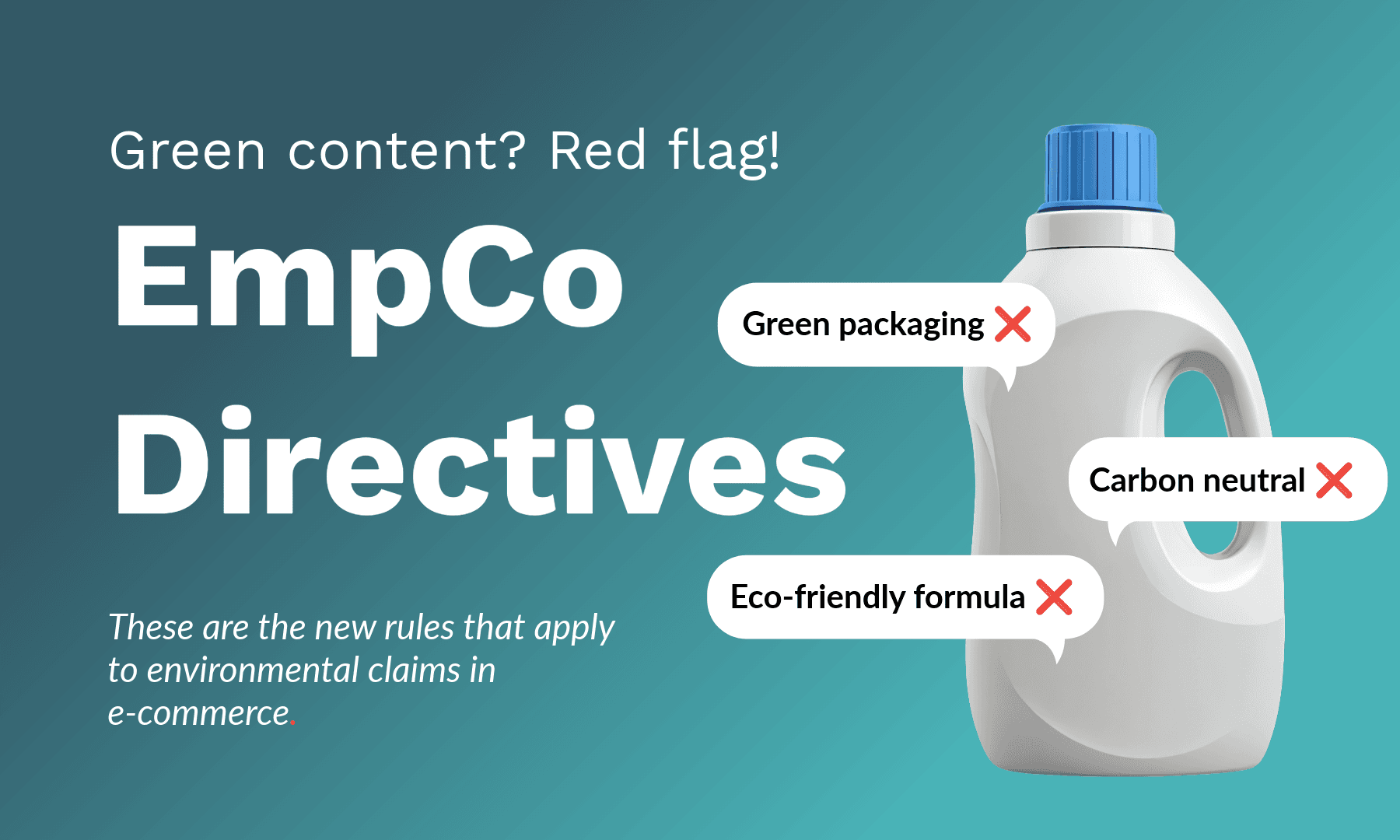
From 27 September 2026, new rules apply to environmental claims in e-commerce. Wording like “eco-friendly” or “climate neutral” stops being arguable and becomes, in many cases, simply unlawful. Including on every listing that is already live. 

Inna Dickmänken
Inna Dickmänken
Head of Product
Sep 09, 20264 min read

For a brand with several thousand ASINs across five markets, that is not a campaign adjustment. It is a job for the entire catalogue. It sounds like more work than it turns out to be: the affected vocabulary is a manageable set, and most of the work is translation rather than deletion. 

What exactly changes on 27 September? 

Behind the date sits Directive (EU) 2024/825, known as EmpCo. It is not a separate law; it amends existing consumer and competition law. In Germany the implementation is an amendment to the UWG, published in February 2026. There is no transition or sell-through period. 

One phrase carries the whole change: per se. Until now, someone had to demonstrate that a particular claim in a particular context misled a consumer. From the cut-off, several environmental claims sit on a blacklist, and anything on that list is unlawful without any case-by-case assessment. What stays uncertain is no longer the legality of the claim, only whether anyone looks. 

That is where it gets uncomfortable. In Germany, enforcement runs largely through private action: competitors, the Wettbewerbszentrale and consumer associations. Because no proof of actual deception is needed any more, the cost of bringing a case drops sharply. A screenshot comes close to sufficient evidence. If you already manage Amazon with a compliance lens, the pattern is familiar from the GPSR obligations: a single field decides, and it never shows up in standard reporting. 

Which claims become unlawful? 
  • Generic environmental wording without evidence: Eco-friendly, environmentally friendly, green, climate friendly, sustainable, natural, resource saving, plastic free, biodegradable. These survive only with recognised excellent performance behind them, such as the EU Ecolabel, the Blue Angel or the highest energy efficiency class.
  • Partial claims that sound like whole-product claims: “Sustainable toothbrush” when only the handle is bamboo. Almost every sustainability story on Amazon is built this way: one good attribute, pulled to the top.
  • Climate neutrality based on offsetting: This one is absolute. Certificates and third-party verification do not save the claim. The German Federal Court of Justice ruled on this in 2024, before EmpCo even applied.
  • Self-made sustainability labels: If you built your own green badge to look like a certificate, you lose it.
  • Legal minimums presented as a benefit: “Plastic free” on paper, or “microplastic free” where microplastics are already banned. Cosmetics is hit hardest, because free-from claims are a category convention there.
  • Future commitments without a plan: “Climate neutral by 2030” in the Brand Store, with no verifiable commitment and no realistic implementation plan behind it.

There is a seventh point that has nothing to do with greenwashing and is routinely missed: for goods with digital elements you now have to state the period covered by software and security updates, plus information on repair and spare parts and a harmonised notice on statutory warranty rights. So for beauty, food and household the topic is vocabulary. For consumer electronics it is missing mandatory information. 

Where do these claims sit in a listing? 

Wider than most teams assume. The rules cover not only sentences but images, symbols, seals and even brand and product names, as soon as they convey an environmental benefit. On a product detail page that means the title, bullets, description, A+ content including the text inside its graphics, secondary images, the Brand Store, and the names of variations and product lines. 

The last two are the ones almost nobody has on their radar. A sub-line called “EcoLine” is an environmental claim in the legal sense, and that cannot be fixed by rewriting a bullet point. 

One more thing slips through routinely: seals and green icons that exist as pixels inside an A+ graphic are out of reach for a plain keyword search. That is exactly why most brands never find them, even though the clearest infringements tend to sit there. 

What can you still say?

No longer permittedEco-friendly packaging
Still worksBottle made from 50% recycled PET
No longer permittedClimate neutral
Still worksCO2 per unit reduced by 30% since 2020
No longer permittedSustainably produced
Still worksManufactured with 100% renewable electricity
No longer permittedBiodegradable
Still works94% biodegradable per OECD 301B
No longer permittedOwn green seal
Still worksEU Ecolabel, Blue Angel

Why the working window is tighter than the date suggests 

There is no sell-through window. From the cut-off, non-compliant claims are unlawful on stock and material produced earlier. Every ASIN that is live is in scope, not just newly created ones. 

Then there is lead time. A+ approval, image production and feed cycles take weeks. Work commissioned in early September will realistically not be live by 27 September. 

Enforcement will be selective rather than systematic. No authority scans catalogues automatically on 28 September. What gets picked are recognisable names and clear-cut cases: a long-tail ASIN with “eco” in a bullet is not the first target, a bestseller with “climate neutral” in the title is. And the expensive part is rarely the cease-and-desist itself but the undertaking signed afterwards, which binds permanently and carries a contractual penalty for every repeat. 

This is why a single check in August is not enough. Amazon began replacing over-length titles with AI-generated versions in late July 2026 under the title change to 75 characters. A catalogue that is being rewritten automatically is the worst possible place to rely on a snapshot. 

How Remdash helps you check 

This is what our claim audit is for: a one-off inventory of the critical wording across the entire catalogue, optionally extended by monthly monitoring that keeps the check live after the cut-off. 

Finding the claims is automated across text and images. Title, bullets, description, A+ modules and attributes are already held as text in Remdash, our AI-powered growth platform for Amazon, because every monitored product page is monitored at least daily. Claims that exist as pixels inside an A+ graphic are read automatically as well. 

The next step is automated too, and few people expect it: deciding whether a word is actually being used as an environmental claim. “Green” on a green kettle is a colour, not a claim, and the tool works that out. Only genuinely ambiguous cases go to a human. In a recent audit that was nine items out of 4,021. The legal call on the flagged set stays with your legal team, but they are looking at a filtered list rather than doing the finding. 

Important

One boundary belongs stated: the audit flags wording that is likely to be critical and filters out what plainly is not. It does not assess legal compliance. Any tool promising otherwise is selling an assurance that cannot exist.

After the audit

For the correction, Content AI writes localised versions from your master content and style guide across several languages, rather than translating word for word. The approved target content sits in the CMS, and for vendor clients the Auto Uploads push corrections back through the official Amazon API without a Vendor Central login. If a deleted claim reappears later, the same comparison that runs against unauthorised changes catches it, as described in the piece on content protection.

Frequently Asked Questions

Yes. No sell-through or transition period is provided. From 27 September 2026, non-compliant claims are unlawful on existing listings too. For a marketplace catalogue this is the decisive difference to a campaign adjustment: the scope is the entire live inventory. 

Not where it rests on offsetting. The prohibition is absolute here, and neither project documentation nor third-party verification helps. What remains permitted is a substantiated reduction claim, for example a quantified emissions reduction per unit with a baseline year and a stated method. 

Rather the opposite. It requires a recognised third-party certification or an Amazon programme, which puts those products on the safer side. As an indicator of legal risk it does not work. 

Share this article

Remazing Group
Book a demo

Are you interested in an expert analysis of your portfolio?

Request free analysis
remazing newsletter

Stay ahead on Amazon

The monthly Remazing newsletter. Marketing shifts, no fluff.