

After starting Remazing as an Amazon agency, we quickly realized how tedious working with content on Amazon can be. Content creation took place in Excel lists that had to be checked manually. This was a large pain point: counting words, tracking keywords, copying everything out one by one. It was clear to us that we didn’t want to be an agency that was mainly busy with diligence tasks that were regularly repeated and took up a lot of time. Everyone at Remazing should be able to work in an automated and smart way so that they can devote themselves fully to the content-related tasks on the online marketplace Amazon.
So it was clear: we needed a tool that would do the work for us – or at least make it easier. And since there was no suitable tool on the market at the time, we had to develop one ourselves. The idea for Remdash was born.
In the following, we will briefly outline how Remdash developed from our exclusively internally used system to an independent Amazon tool. Remdash can now be used by companies as a software solution without having to use other agency services.
1. Amazon Content Management System
Initially, Remdash was a content management system (CMS) for Amazon. For each of our clients up to 100 rules were consigned in the program, which mapped the respective style guide for the content on Amazon. How many bullet points should be used in the product description? How long should each title be? How much text should be on the product page? How many keywords? These rules were added individually to the system for each customer.
At that time, this feature of Remdash as a content management system was already unique on the market. There was no dynamic CMS for Amazon that covered the Amazon guidelines and best practices in marketing – not to mention individual customer requirements.
2. Live comparison with Amazon
We soon noticed that content on Amazon often didn’t look the same as it did before in Remdash. Sometimes only the display was different, but sometimes the entire text on the platform was obviously not updated. So we needed a solution to verify that the content on Amazon looked exactly as we had created it in our system.
In the next step, our software developers therefore developed the live comparison of the Amazon product description with the text in the tool in Remdash. The comparison function makes the current status of the content in Remdash visible at a glance – divided into title, bullets and description.
3. Monitoring
The next function we added to Remdash was the monitoring. Now that the content for Amazon could be created in our own tool and a current status comparison was always available, we also wanted to be able to analyze the data from Amazon. For this reason, Remdash was further developed so that it tracks all KPIs on an Amazon product page. From sales ranks to ratings, all data is available in Remdash and can be processed for data analysis. The basis for monitoring the PDP (Product Detail Page) and the possibility of constant optimization was thus created.
4. Dashboards
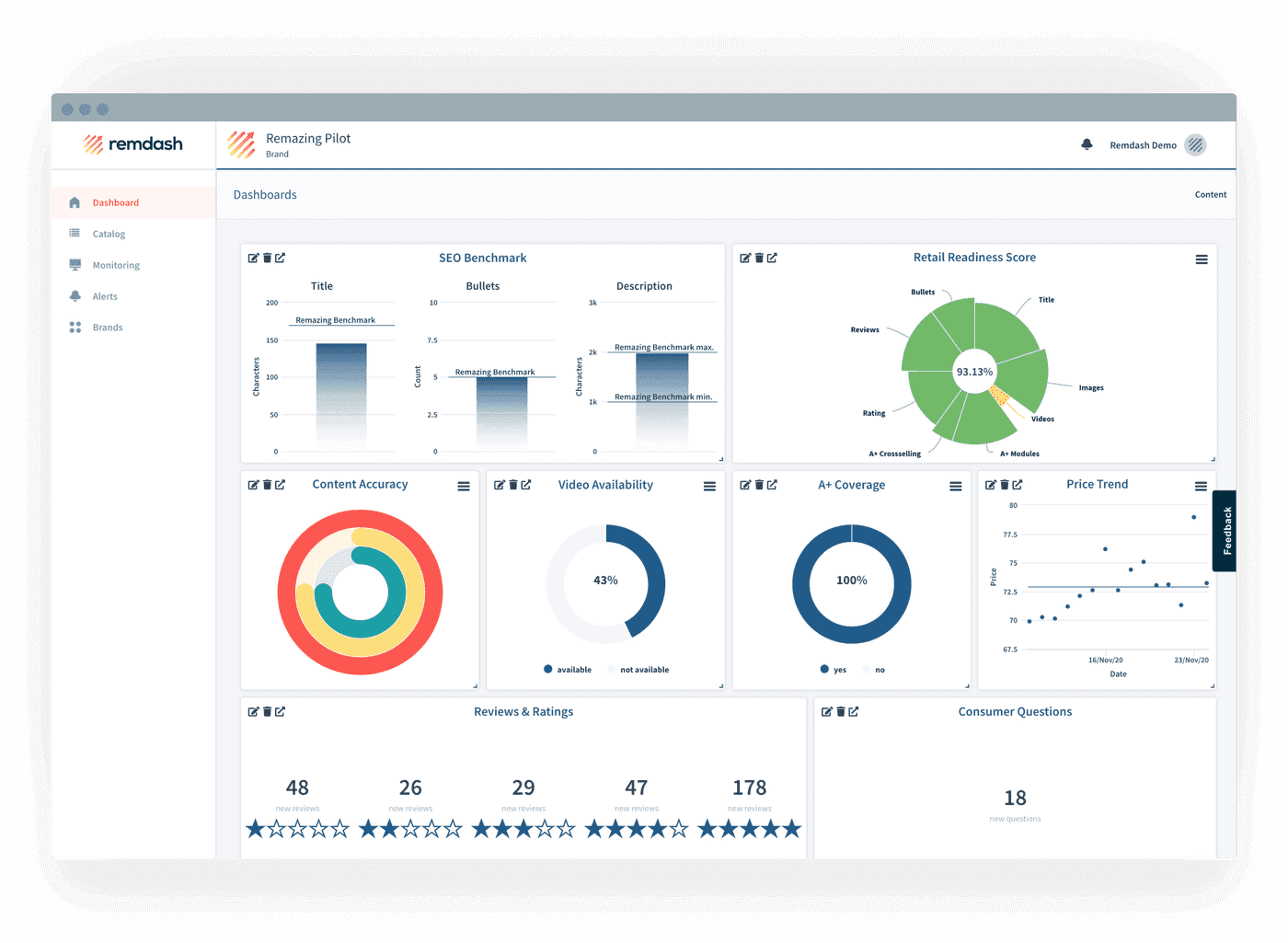
Remdash then took another step towards extensive Amazon optimization with the dashboards. From this point on, it is possible to individually compile your own dashboards with relevant key figures in the tool. The so-called “widgets” in the dashboards provide a quick overview of the important KPIs: How is the traffic and conversion rate? Are images, videos and A+ content on the product detail pages? How about the pricing trend on Amazon and other online marketplaces? Which ASINs are not available right now? Which are the KPIs for the different marketplaces? Of particular note here is the Retail Readiness Score: a figure developed specifically for Remdash that uses various factors to calculate the extent to which the product is ready for Amazon Advertising (Sponsored Ads, Promotions, DSP).
The dashboards help to discover optimization potential and to react quickly if something on Amazon is not as desired. That’s why we also made the dashboards on Remdash accessible to our customers. With their own access, they can thus view the live status of their products on Amazon at any time.
5. Stand-alone tool with continuously new features
Today, Remdash is a stand-alone Amazon tool that customers use independently of our other services.
We are continuously working on our ambitious goal to develop the best Amazon tool worldwide. Therefore, Remdash is constantly evolving and adding new features. The latest update was the automated case upload to Amazon: Vendors no longer have to contact Amazon support by mail to upload new content, but can initiate the process with a few clicks in Remdash. And we’re already working on new features!
remazing newsletter
Stay ahead on Amazon
The monthly Remazing newsletter. Marketing shifts, no fluff.