All Resources
Amazon SEO for Rufus: What It Actually Uses From Your Listing
Blog

Amazon SEO for Rufus: What It Actually Uses From Your Listing

Amazon SEO includes Rufus, so we tested 14 content surfaces in 4 EU marketplaces to see what it actually credits as a source. Texts made it, but images never did. Keep reading to find more insights.

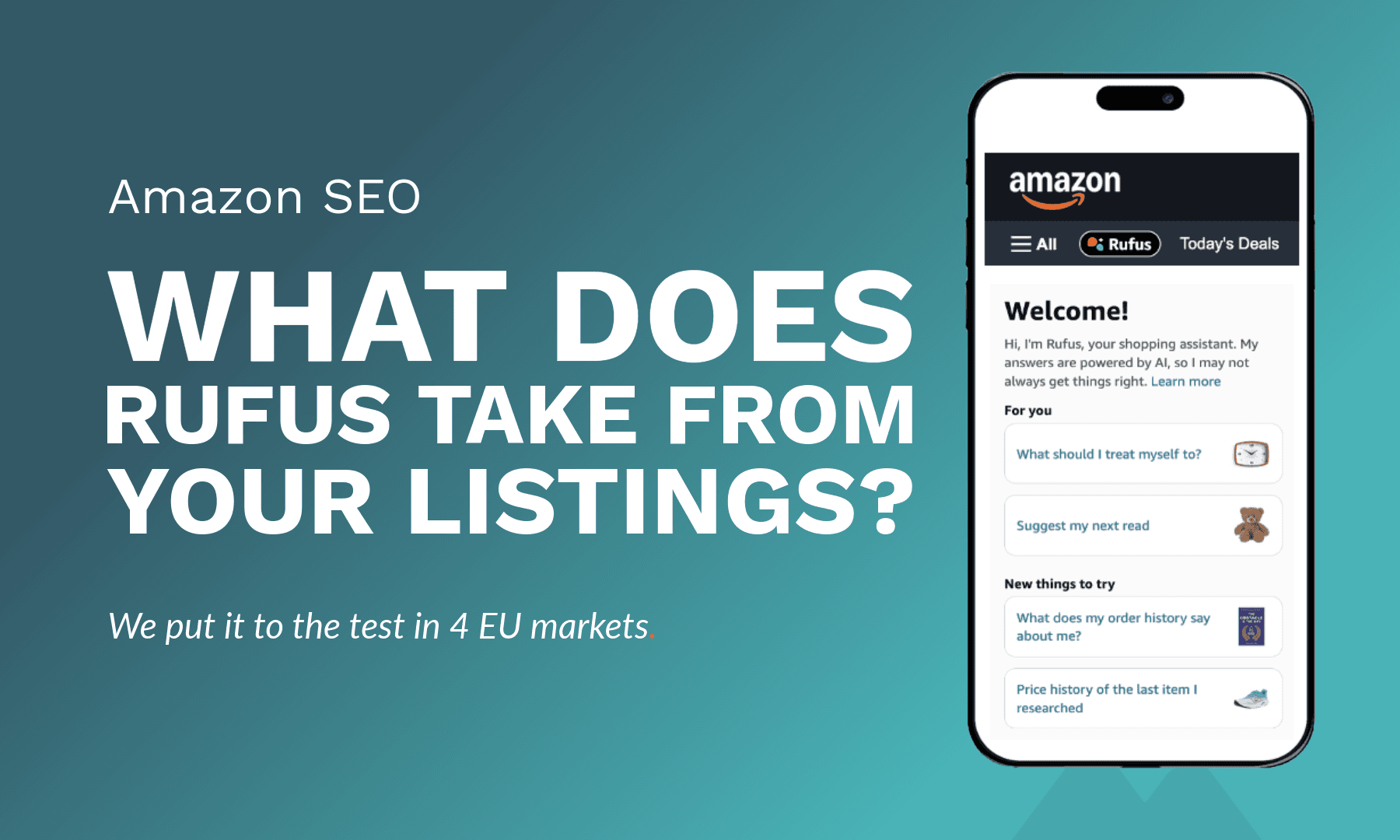
Rufus is Amazon's AI shopping assistant. Shoppers ask in plain language, and Rufus answers with a short set of products and the reasons they fit. In our earlier post on Rufus we explained why that shifts visibility from ranking to being recommended. For Amazon SEO, that adds a second job: a listing still has to rank on Amazon, and now it also has to give Rufus something it can use.

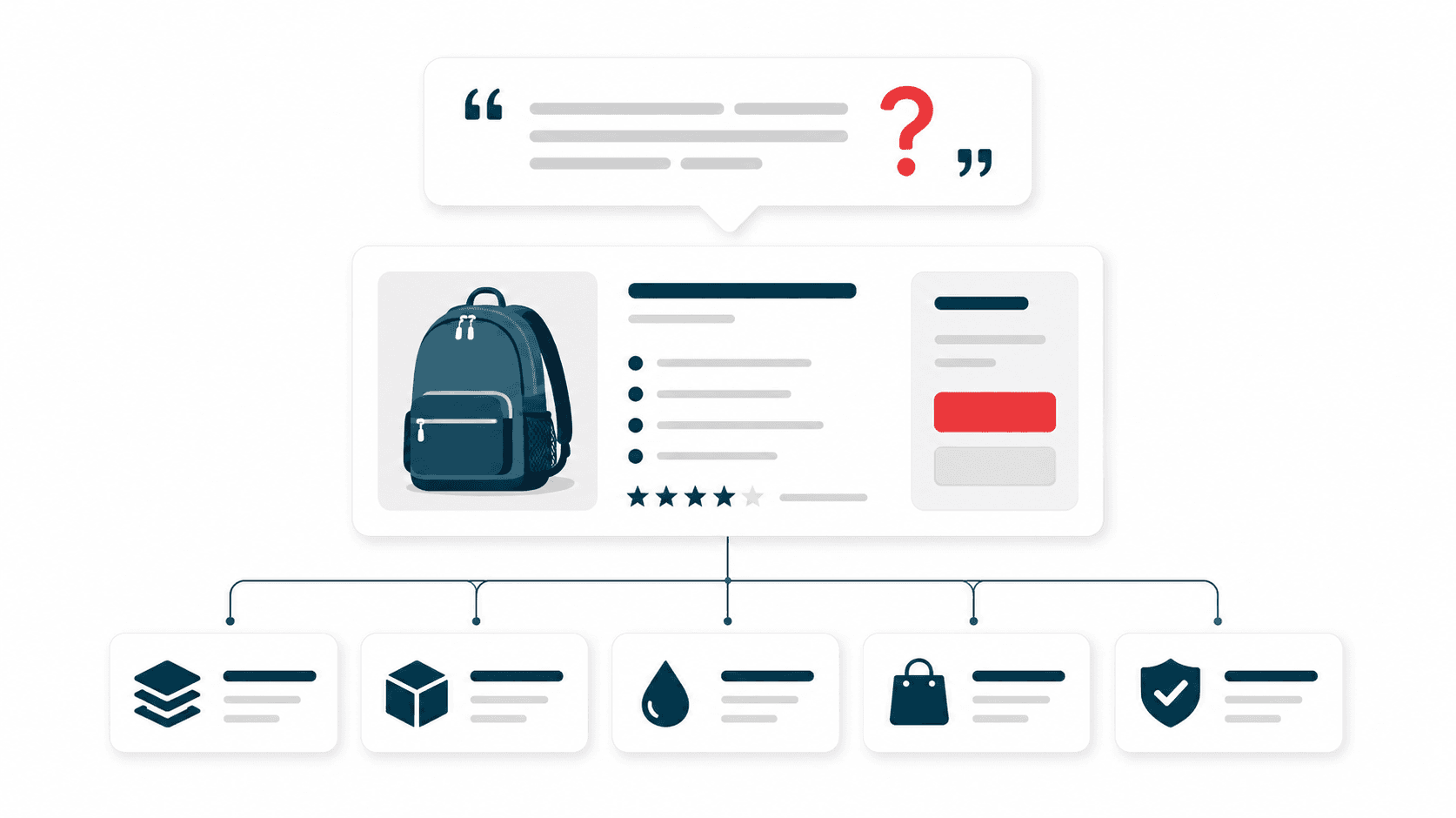
Plenty of listing elements are said to be indexed: titles, bullets, descriptions, reviews, Q&As, even images, but Amazon has never confirmed which of them Rufus actually pulls into an answer. So we tested it. One question ran through the study: which parts of your listing can Rufus actually use?
Key Takeaways
  • Rufus credits text, not images: 83% of text-field tests came back with the field credited as the source. For text carried on images, A+ included, it was 0 of 14.
  • Inside A+, the format decides: The text-based A+ Q&A module was credited in DE, ES and FR. A+ and Brand Story modules with text baked into the graphic never were.
  • The plain description outlives A+: Rufus kept crediting the description on pages where A+ had replaced it on screen.
  • Thin attributes hand the answer to reviews: Where attribute fields were thin, as in Adhesives & Home Care, Rufus filled the gaps from review text.
  • Attributes nobody else claims beat review volume: When a shopper asks for attributes only your copy states, Rufus leads with your product, even with far fewer reviews. In DE, a product with 43 reviews came first, ahead of one with 1,582.
  • When products match equally, reviews decide: On broad queries, or when competitors claim the same attributes, Best Seller Rank and review volume break the tie.

How we tested this

Setup

  • 4 marketplaces: Germany, Spain, France and Italy, with one native-speaking content manager per market. Prompts were written the way shoppers type: local language, lower case, loose grammar.

  • 3 categories, 36 products: Skincare, Adhesives & Home Care and Smart Lighting. 10 to 15 products per marketplace, 9 of them tested in more than one market.

  • 116 prompts in Q3 2026: 32 in DE, 22 in ES, 28 in FR, 34 in IT. 85 produced a scored result, 53 on the product page and 32 on the search page.

  • 2 entry points: Rufus opened from the Amazon home page (search page) and from the product detail page.

The framework was the same in all four markets, so differences point at the market rather than the method.

What we tested

A content surface is any place on or around a listing where a brand can put information. We tested 14:

  • Listing text: product title, item highlights, bullet points, listing attributes

  • Customer content: customer reviews

  • Enhanced content: gallery image text, A+ Basic, A+ Premium, Brand Story, range or routine module

  • Merchandising and navigation: cross-selling table, Brand Store, links to external websites

The plain description was not a dedicated test. It shows up in the findings because Rufus named it unprompted when we challenged it on other surfaces.

We challenged every positive result. A correct answer does not tell you where Rufus got it from, so after every positive result we asked: "Where do you see this on the PDP?". A surface only counted when Rufus named it as its source: in one test, Rufus confidently confirmed a patent claim that appeared only on a gallery image. When challenged, it could only point to the text copy, so we logged that as a false positive.

The result per surface and market

SurfaceProduct title
DECredited
SurfaceProduct title
ESCredited
SurfaceProduct title
FRNot tested
SurfaceProduct title
ITCredited
SurfaceBullet points
DECredited
SurfaceBullet points
ESCredited
SurfaceBullet points
FRNot tested
SurfaceBullet points
ITCredited
SurfaceListing attributes
DEPartial
SurfaceListing attributes
ESCredited
SurfaceListing attributes
FRCredited
SurfaceListing attributes
ITCredited
SurfaceA+ Q&A module
DECredited
SurfaceA+ Q&A module
ESCredited
SurfaceA+ Q&A module
FRCredited
SurfaceA+ Q&A module
ITPartial
SurfaceItem highlights
DECredited
SurfaceItem highlights
ESPartial
SurfaceItem highlights
FRNot tested
SurfaceItem highlights
ITPartial
SurfaceCustomer reviews
DENot tested
SurfaceCustomer reviews
ESNot tested
SurfaceCustomer reviews
FRCredited
SurfaceCustomer reviews
ITNot tested
SurfaceGallery image text
DENot credited
SurfaceGallery image text
ESPartial
SurfaceGallery image text
FRPartial
SurfaceGallery image text
ITNot credited
SurfaceA+ Basic body copy
DEPartial
SurfaceA+ Basic body copy
ESNot tested
SurfaceA+ Basic body copy
FRNot credited
SurfaceA+ Basic body copy
ITNot tested
SurfaceA+ Premium body copy
DENot credited
SurfaceA+ Premium body copy
ESPartial
SurfaceA+ Premium body copy
FRNot tested
SurfaceA+ Premium body copy
ITNot tested
SurfaceCross-selling table
DENot credited
SurfaceCross-selling table
ESCredited
SurfaceCross-selling table
FRPartial
SurfaceCross-selling table
ITNot credited
SurfaceBrand Story
DENot credited
SurfaceBrand Story
ESPartial
SurfaceBrand Story
FRNot tested
SurfaceBrand Story
ITNot tested
SurfaceBrand Store
DECredited
SurfaceBrand Store
ESCredited
SurfaceBrand Store
FRNot tested
SurfaceBrand Store
ITNot tested
SurfaceExternal websites
DENot credited
SurfaceExternal websites
ESPartial
SurfaceExternal websites
FRNot tested
SurfaceExternal websites
ITNot credited

"Partial" also covers results where the source stayed unclear. Brand Store counts as credited only on the shopper's second ask. The top six rows are stored as text; the rest are images, modules or off-listing destinations.

Read these results as direction, not magnitude

Rufus is generative and we ran each prompt once, so a second run can return different answers, products and sources. Rufus also carries context within a session, and one French test account had bought from a brand before testing, which then took 3 of 5 slots in an unrelated sub-category. In Italy, 7 of 16 product-page tests could not run because the products were not live there. Some findings rest on only a few prompts.

Five Amazon listing optimization steps for Rufus

These steps do not replace your Amazon SEO strategy for organic ranking. They add the layer Rufus reads.

  1. Put every key claim in text. If a claim only lives on an image, Rufus cannot credit it. Mirror it in the bullets, description or attributes, and keep images for conversion.
  2. Use the A+ Q&A module for the wording you want repeated. It was the one enhanced module Rufus credited as a source. Rufus answered with the module's own wording, so write it the way you want it quoted.
  3. Keep the description alive. Rufus still credited it after A+ replaced it on screen. Update it whenever the rest of the listing changes.
  4. Fill every attribute field. Where metadata is thin, Rufus fills the gap from review text, and you lose control of the answer.
  5. Claim the attribute combination nobody else claims. Check which attributes your competitors leave unstated, and state them explicitly in your copy. In crowded categories where everyone claims the same, build reviews first.

How Customer Signals can help

Checking this by hand across hundreds of ASINs is not realistic. Customer Signals, a unique feature of our e-commerce platform Remdash, reads copy, images, reviews and questions together and scores every ASIN for how discoverable it is to Rufus.

  • Scoring: a Rufus Score per ASIN, broken down into its individual signals.
  • Rufus Questions: insights into the questions Rufus receives and how well your products answer them.
  • Customer Feedback: reviews summarized and grouped into praise and pain points.
  • Actions: the scores turned into a prioritized list of fixes.

Because text and images are read together, including OCR, Customer Signals also flags claims that are stranded on an image and missing from the copy. It works with public Amazon data only and is ISO 27001 certified.

Getting started takes three steps: tell us your marketplaces, share your ASIN list (20 to 100+ per marketplace), and the first scores land in about a day.

Request your Customer Signals analysis and start your Amazon Rufus optimization now.

Frequently Asked Questions

Not in a way we could prove. Amazon has never confirmed it. In our tests, no image was credited as a source in any market (0 of 14). Where Rufus answered partly, the same content also existed in the copy.

No, but the format matters. The text-based A+ Q&A module was credited in three of four markets. A+ and Brand Story modules with text baked into the graphic were not. We did not test A+ overlay text, which is stored as a real text field.

We did not measure organic ranking, so we cannot say. What we measured is whether Rufus picks a product and which parts of the listing it quotes. Complete text and attributes are part of any Amazon listing optimization anyway, so the five steps above fit into the work you already do.

Yes, if it states attributes no competitor claims. In DE, a product with 43 reviews was ranked first for a three-part sun protection query because it was the only one stating all three. In IT, a competitor already made the same claim, and Rufus led with a product holding 17,439 reviews instead.

No. As described in our earlier post on Rufus, Rufus first decides which products are relevant enough to enter an answer. Only then does Amazon's ranking algorithm rank them by signals such as sales velocity and Best Seller Rank. A strong page-1 ranking does not guarantee a Rufus mention.

Remdash Customer Signals

See your listings the way Rufus does

Share this article

remazing newsletter

Stay ahead on Amazon

The monthly Remazing newsletter. Marketing shifts, no fluff.