

Share of voice has been a core visibility metric on Amazon for years, and in 2026 it is worth a fresh look. Since AI search arrived in the shopping flow, the way shoppers find products has started to shift, and that changes what your share of voice number can and can’t tell you. On Black Friday 2025, Amazon’s AI assistant was involved in 38 percent of sessions, and a typical AI answer returns five products, not fifty. If you report SoV to your leadership team, this article walks through what the metric still measures well, where it now falls short, how to build and report it so the number is trustworthy, and how to track visibility in a way that holds up.
BlogRemdash
Amazon Share of Voice in 2026: How to Measure Visibility Properly
Amazon share of voice is changing as AI search shortlists products. Here is what SoV measures, how to build the keyword set, split organic from paid across top 5/10/20, set a reporting cadence, and what Brand Analytics misses.
What share of voice is, and why it still matters
Share of voice on Amazon is your brand’s slice of the visible search results for a defined set of keywords. Put simply: across the searches that matter for your category, how often and how prominently do your products show up versus everyone else’s? It is the closest thing to a single read on whether shoppers are seeing you at the moment they decide what to buy.
The reason it matters is straightforward. On Amazon, most purchases start with a search, and the results that appear on the first screen take the overwhelming share of attention. The first three results collect the lion’s share of clicks, so a strong share of voice on your priority keywords tends to lead the demand that later shows up as sell-out. Watched over time, SoV is also an early-warning signal: a competitor launch, an out-of-stock phase, or a paused campaign usually shows up as a visibility drop before it shows up in your sales figures.
That early-warning quality is what makes SoV more than a vanity metric. Sales figures confirm what has already happened, whereas a visibility shift often shows up weeks earlier. By the time a lost position has worked its way through to your revenue, you have usually missed the window to respond cheaply. A team that watches visibility closely can act on a slipping rank while it is still a small problem, rather than explaining a sales dip a month later.
The one habit worth dropping is treating SoV as a single headline percentage. A category leader can hold a comfortable-looking blended number while losing ground on exactly the generic keywords where new demand is won. The value is in the detail underneath, and in 2026 there is a new layer to add to that detail.
How visibility on Amazon is changing in 2026
The change worth understanding is the rise of the AI shopping assistant. Amazon’s assistant launched under the name Rufus, and in May 2026 it was renamed Alexa for Shopping in the US, merging Rufus and Alexa+ into one assistant. The behaviour that matters for visibility is the same either way: when a shopper asks for “the best wireless headset for a home office,” they don’t get a page of fifty options to scroll. They get a short, named shortlist, usually around five products.
That has a real consequence for how you read SoV. On a classic results page, visibility is gradual. You can sit at position six, climb to position four, and measure the progress. Inside an AI answer, there is no position seven that half-counts. For that query, your product is in the shortlist or it isn’t. So alongside your familiar page-based SoV, a growing share of high-intent demand now resolves in a place where visibility is closer to all-or-nothing, and your top-10 number simply can’t see it.
The sponsored side is shifting too. Sponsored Brands now appears in an AI-assembled collections layout, and ad placements inside the AI answer have been billable since 25 March 2026, with many campaigns auto-enrolled. So some brands are already paying for visibility inside the assistant that was free in beta only months earlier, which makes keeping paid and organic visibility separate more important than it used to be.
The trust threshold behind the AI shortlist
There is one detail that often surprises teams who feel they have already done the content work: the AI shortlist gates on trust before it weighs your copy. In practice, products under four stars are largely absent from the answer, and review volume acts as a gate rather than a tie-breaker, with recommended products tending to carry reviews in the thousands rather than the hundreds. A product at 3.9 stars, or one with a strong rating but only a couple of hundred reviews, can be excellent on every content axis you control and still miss the shortlist.
What the AI reads to judge relevance is worth knowing too. It reads the attribute fields first, the structured backend data rather than the visible bullets, and it treats recent reviews and Q&A as facts that can override your catalogue copy. The graph behind these answers is also built per marketplace from local purchase patterns, so strong US visibility does not automatically carry to DE or FR. None of this appears in a top-10 share number, yet it helps decide whether you make the shortlist at all.
The practical takeaway is that AI visibility and classic visibility can move independently. You can climb the organic ranks and still be filtered out of the shortlist on a trust signal, or hold a strong rating and lose ground because a competitor’s recent reviews now describe a use case the model has learned to favour. If you fold both into one number, the gap between them is the first thing you stop seeing.
How to measure share of voice properly
The practical answer is not to abandon SoV but to report it in layers instead of one figure. Pacvue and other retail media platforms have settled on a three-layer measurement for the classic surface, and in our brand setups we run those three and treat a fourth as the emerging layer.
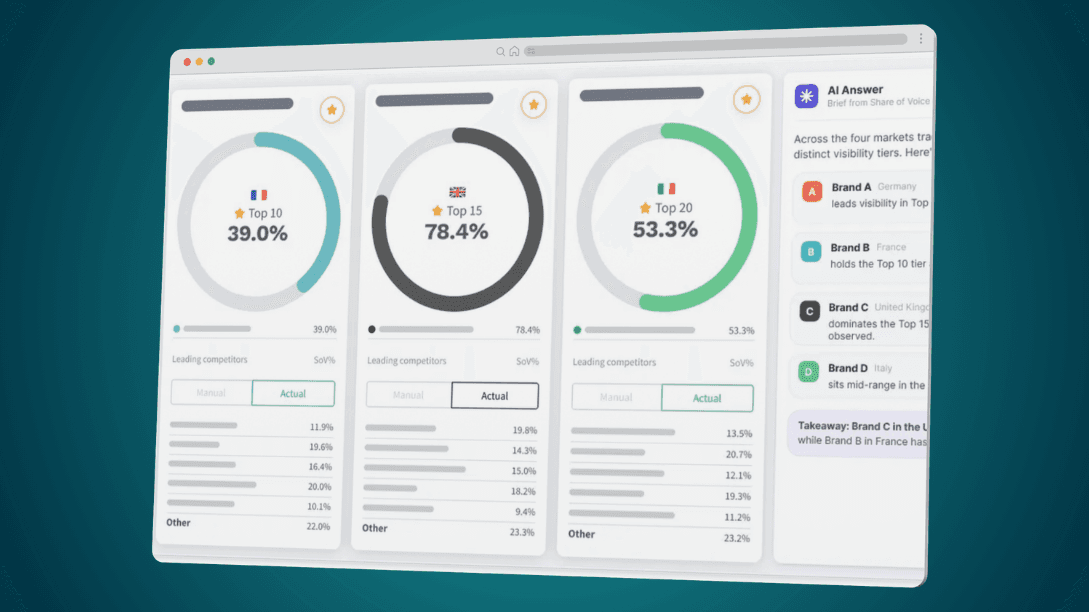
Organic SoV is your share of the unpaid positions on a defined keyword list, weighted by rank and by whether a result sits above or below the fold. The detail that matters in 2026 is the band: report it across top 5, top 10 and top 20 rather than collapsing it to one number. In a category where the AI shortlist and the top three do most of the work, your top-5 share and your top-20 share genuinely tell different stories.
Paid SoV is your share of sponsored placements: Sponsored Products, Sponsored Display, and Sponsored Brands in its AI-assembled collections layout. Keep it strictly separate from organic. A blended figure that leans on paid placements can hide an organic position eroding underneath, and you won’t notice until you cut ad budget and the visibility falls away.
Total SoV is the weighted combination of the two, and it is only useful when you cut it by branded, competitor and generic keywords. Holding your own brand name is the baseline you are expected to clear; the real growth comes from gaining ground on the generic head terms.
The fourth layer is the new one, and no native tool measures it cleanly yet. AI Share of Voice is the share of relevant conversations in which the assistant names your brand at all. It belongs on every twelve-month roadmap even though it is hard to instrument today. A first approximation is available through our Customer Signals tool, which deliberately sits outside the main platform for now, because the methodology is still moving as fast as the surface it measures.
Building the keyword set you measure against
A share of voice number is only as good as the keyword set behind it, and this is the step teams most often rush. The instinct is to track the head terms everyone already knows, but a list of twenty obvious keywords flatters the brands that already lead them and tells you almost nothing about where demand is moving. A useful set is broader and more honest about the category.
In practice a good list mixes three kinds of term. Branded keywords confirm you own your own name and catch hijacking or competitor conquesting early. Generic category terms, the unbranded head and mid-tail searches a shopper uses when they have not yet decided on a brand, are where new demand is won and where most of the strategic value sits. Competitor terms show you where rivals are pulling traffic you could contest. Skewing the list toward only one of these gives you a number that looks stable while the part that matters drifts.
Two practical points keep the set healthy. First, size it for coverage rather than convenience: a real category usually needs several hundred keywords per marketplace to represent how shoppers actually search, not a tidy top twenty. Second, revisit it on a schedule, because search language shifts, new terms appear after a product launch, and a list left untouched for a year stops describing the category. Plan to maintain the set, rather than building it once and leaving it.
Why organic and paid have to stay separate
It is worth being concrete about why the organic and paid split is not just tidiness. The two layers answer different questions and respond to different levers. Organic SoV reflects the durable equity of your listings: relevance, conversion history, reviews, availability. Paid SoV reflects how much you are spending and how well your campaigns are structured right now. Average them together and you get a number that moves for reasons you can no longer separate.
The failure mode is familiar. A brand holds a healthy blended SoV through a strong quarter of ad spend, the organic position underneath erodes month by month, and nobody notices because the headline looks fine. Then the budget is trimmed, the paid layer thins out, and the organic weakness is suddenly exposed all at once. Reporting the layers separately would have shown the organic slide while there was still time to address it, rather than presenting the whole decline as a single surprise.
Setting a reporting cadence that people act on
Measurement only changes decisions if it lands in front of the right people at the right rhythm, and the right rhythm is not the same for every audience. The data underneath should refresh frequently, but the reporting on top of it should be paced to how often each team can actually act.
For the people managing the account day to day, a near-daily read on the priority keywords is appropriate, because a sudden visibility drop, an out-of-stock event or a competitor’s new campaign needs a response in days, not weeks. For a brand manager, a weekly summary of what moved, which competitors gained, and where the biggest keyword shifts happened is usually the right grain. For leadership and business reviews, a monthly or quarterly view that ties visibility to sell-out and shows the trend across markets is what gets read and remembered.
The mistake to avoid is reporting at the wrong altitude for the audience. A daily firehose of position changes overwhelms a leadership review and gets ignored; a quarterly summary is far too slow for the person who has to fix a slipping rank this week. Match the cadence to the decision, keep the underlying data fresh enough to support the fastest of those cadences, and the report turns into something people actually work from rather than glance at and set aside.
Common measurement mistakes to avoid
A handful of recurring mistakes undermine otherwise solid SoV programmes. They are easy to fix once named.
The first is the single headline number, covered above but worth repeating because it is the most common: a healthy blended percentage that hides an organic decline or a missed AI shortlist. The second is an unweighted count, treating position one and position nineteen as equal when their value to the shopper is nothing alike. A flat list of “where do we appear in the top twenty” rewards thin presence over real prominence, which is why position weighting matters as much as coverage.
The third is comparing marketplaces that were never measured the same way. If DE is reported on one keyword set and band logic and UK on another, a side-by-side comparison is misleading rather than informative. The fourth is a stale crawl: visibility data that is days old reaches you after the event it describes has already moved your sell-out, which turns an early-warning metric into a lagging one. The fifth, increasingly common in 2026, is ignoring the AI surface entirely, reporting a confident classic SoV in a category where a growing share of intent now resolves in a five-product answer the report cannot see. None of these require exotic tooling to avoid, only the discipline to weight by position, standardise across markets, refresh fast, and report the AI layer even when it is only an approximation.
What Amazon Brand Analytics doesn’t show
If you have tried to build this from Vendor Central and Brand Analytics, you have probably hit the limits. Brand Analytics shows the top three ASINs per search term and nothing below, so if your brand sits at positions four through ten, where much of the climbing happens, you are effectively invisible to the report meant to track your visibility. It also lands with a delay, which means a competitor launch reaches your numbers only after it has already moved your sell-out. And it gives each marketplace in its own format, with no clean way to put DE, FR, IT, ES and UK side by side in one currency and one visibility band.
That is why a serious SoV setup tends to live outside the native tools. The native reports are useful for what they were built to do, but they were never designed to produce what you now need: position-weighted bands across markets, organic split from paid split from AI surface, refreshed fast enough to act on. You need a crawl of the actual results pages, run at least daily and evaluated by position rather than as a flat list. For 800 keywords across five marketplaces that is on the order of 4,000 crawls a day, which only works if it is automated.
How Remdash helps
Inside this kind of setup, the tracking work is done by Remdash, where share of voice is one of the longest-standing modules. Since December 2025 it runs a weighted SoV model that scores by the real search-term rank distribution rather than a flat position count, reports organic and paid separately across the top 5 / 10 / 20 bands, and lands in the same custom dashboards as your advertising and availability data. The Remdash chatbot, in private beta since April 2026, can hand a brand manager the short version (top competitors, biggest keyword shifts, and what moved since the last review) without a tour through five dashboards.
A practical example helps more than another framework. Kellanova, the company formerly known as Kellogg’s, sells across DE, UK, FR, IT and ES. Before continuous tracking, the picture was a common one: low visibility on generic category keywords, out-of-stock phases quietly pushing ASINs out of the index, and competitors not watched in any structured way. The build was deliberately unglamorous: a curated list of around 800 keywords across all five marketplaces, automatic identification of the competitors that actually showed up in those results (including private labels and long-tail brands that never make a classic competitive set), and the visibility data wired to advertising and the ordering algorithm so a drop could be read for what it was.
Over six months, visibility on generic keywords climbed by about 240 percent, and sell-in rose 331 percent over the same window. To be straight about it, that is one brand, in its categories, over half a year, and the size of any lift depends heavily on where you start and who you are up against. The exact figures won’t repeat, but the approach behind them does carry over: a well-built keyword set, position-weighted bands, organic kept separate from paid, and a refresh fast enough that a drop is caught while it is still small.
“Remdash is part of every business review and a fundamental tool for managing Amazon. It gives me and my team the insights we need to make the right decisions. The clarity of the software stands out compared to other tools.” — Christoph Sterkel, Head of E-Commerce Northern & Eastern Europe, Kellanova
Frequently asked questions
Is classic Amazon share of voice still useful in 2026? Yes. On classic results pages it still tracks real demand, and in categories the AI hasn’t heavily entered it remains a fair proxy for visibility. The thing to avoid is reporting it as a single healthy percentage when a growing share of intent now resolves in a five-product AI answer your top-10 number can’t see. Treat it as one layer among several, broken out by band and keyword type.
How many keywords do I need to track for a reliable Amazon share of voice number? More than the obvious head terms. A reliable read usually needs several hundred keywords per marketplace, mixing branded, generic category and competitor terms, because a short list of head terms flatters whoever already leads them and misses where new demand forms. Just as important, revisit the set on a schedule, since search language shifts and a list left untouched for a year stops describing the category.
Can AI Share of Voice actually be measured today? Only approximately, and the methodology is still moving. You can’t pull it cleanly from Brand Analytics, and any precise, audited figure should be treated with caution. What you can do is sample relevant conversational queries and track whether your brand is named, which is what our standalone Customer Signals score does at omr.signals.remdash.io. An approximate read you can act on is more useful here than waiting for a precise one.
See where your portfolio stands
If you want to see where your portfolio sits across these layers, book a demo. We will pull live keywords from your category, split organic from paid across the top 5 / 10 / 20 bands, and show you which queries are already resolving in the AI shortlist.
remazing newsletter
Stay ahead on Amazon
The monthly Remazing newsletter. Marketing shifts, no fluff.